Without Fault
Solo-Developed Single-Player Psychological Horror game with Fixed-Camera perspective in Unity.
-
Project Management (resources, scope, deadlines, etc.)
-
Game Design
-
Level Design
-
3D Modeling
-
3D Animation
-
C# Programming

Watch the Trailer
Design Challenges and Details
As with any game there were issues that either hindered the experience or caused outright flaws that needed fixing. Some of these I tackled preemptively with the knowledge and experience of previous years of work. Others were revealed in the many playtests. Below you can see some of the issues, problem solving and design decisions during development.

Pathfinding is always important. Not only does the Player need to understand where they need to go but also where they can go. This was a reoccurring challenge when working with the Fixed-Camera perspective. Unlike other perspective forms, the camera was locked in a certain angle which could cause certain paths to feel "vague" or "obscure".
Subtle elements were used in each case to help the Player better understand his surroundings and his options.
Other times it was a matter of subtly pointing the Player in the right direction. While the Balcony Door in the picture below was visited by the Player beforehand it was still important to help them visually see their destination when picking up its key. There was also the possibility that some Players would have skipped visiting the locked door beforehand and therefore have no clue as to what the key on the table is for. The design choice below hit both birds with one stone.

On the subject of guiding Player attention; At one point the Player enters the power room and upon fiddling with the power box burns a fuse. An in-world note on the table helps them understand where they can find a space but how do you guide their attention to something that existed before and is only important now? Use of Contrast.
When the power is turned off the entire room is plunged into darkness. The only remaining source of light? A flashlight on the table (which was off beforehand). It shines bright white, creating a big contrast with its black surroundings. It's shining light exactly on the note the Player must now read.

I had planned to take it further by having the light turn on with a small delay and flicker with sound when doing so, helping grab the Player's attention even more. However, playtests showed that Players didn't have a problem finding the note in its current state and with time being very short, these additions were never applied as it already did its job.

Some puzzles were vigorously playtest to truly work out the kinks and make them feel intuitive and prevent the need for immersion-breaking actions such as taking real world notes or using calculators.
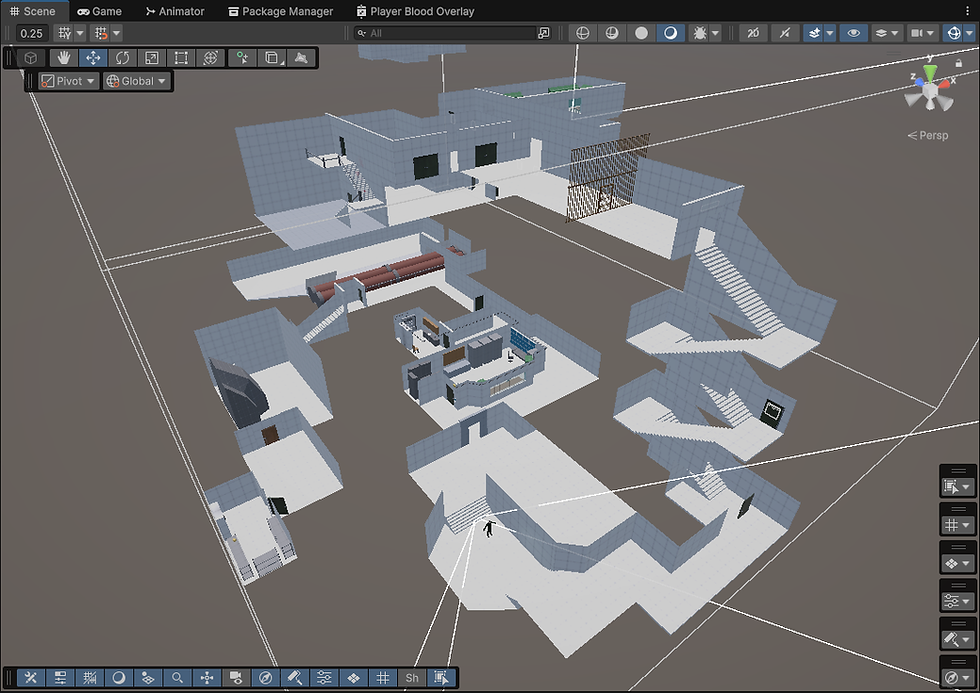
As always, all of these levels and scenarios all started with simple Probuilder Blockouts to allow for rapid prototyping without the clutter that the later stages bring.