Plucked From Reality
Goal: Create an Arena Shooter Deathmatch level with only 20 brushes.

A map jam was held for Half-Life where the goal was to make a DM map with only 20 CSG brushes. These "brushes" are meshes that can only hold primitive shapes, mostly cubes.
CSG Brush Limits
The GoldSource engine uses a CSG system to create the level's mesh structure. These meshes are called "brushes" and there are limits to how you can use them; Each brush shape needs to be both convex and planar. Anything outside of these will throw errors during compiling, forcing you to simplify the shape or cut it up into multiple brushes which for this jam meant reducing my overall number of brushes. Below you can see some x-ray examples of what is acceptable and what is not.

Workflow
20 brushes was a limit you couldn't work with on paper. Instead I jumped straight into the editor, placing brushes and creating different layouts, seeing what works in the actual 3D space.
The map's theme of objects having been plucked out of reality and held afloat by unknown forces was also derived from this workflow.
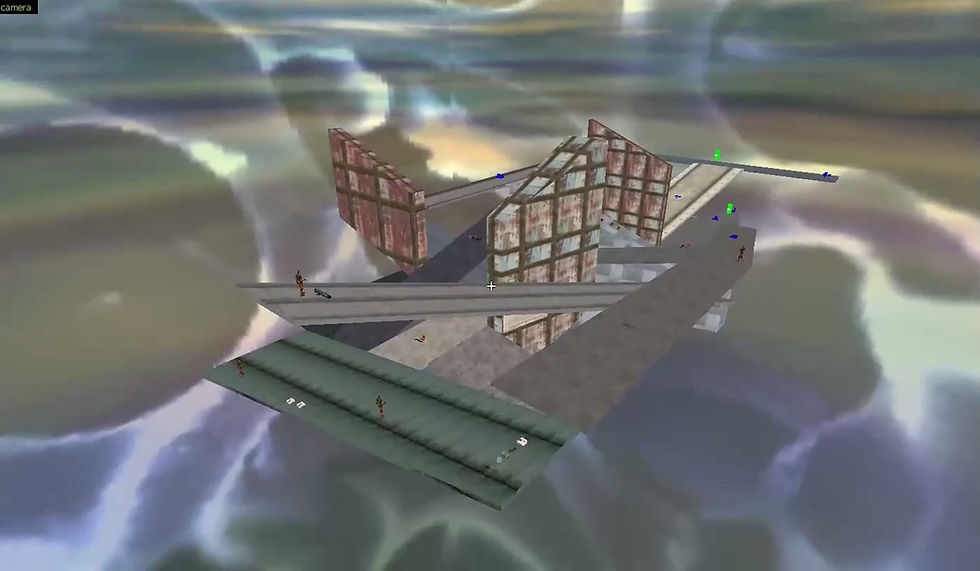
A fly-around video to understand the space
Following this workflow I came up with a design that split the map into 3 different floor heights, each holding their own resources and directly influencing how you play the map.

3 walls (highlight purple below) were placed to break up line-of-sight in different sections, giving Players more "isolation" to stack up and disallowing them from sniping the entire map from a single point. Their skewed shape was also a deliberate act to fully lean into the surreal and abstract theme of the map.

Playtests
Of course like any other design it needed to be tested to see if it had the actual function I intended. In the short time I had I held 3 playtests with 2 types of players: Noobs and Pros.
When making multiplayer maps you should account for both groups. A map's layout and design should be easily understandable by a new Player but also allow experienced Players to pull more advanced tricks such creating their own paths (bunny-hopping over pitfalls) and gauss jumping (rocket jump) across the map to reach certain points faster.


Each playtest helped point out design flaws which I would then fix before the next playtest so that I could uncover them all and take them out one by one. This lead to the final product playing amazingly and getting positive reception.